Are you attending lots of outpatient appointments in different departments? Please share your story to help us improve.

Share Are you attending lots of outpatient appointments in different departments? Please share your story to help us improve. on Facebook Share Are you attending lots of outpatient appointments in different departments? Please share your story to help us improve. on Twitter Share Are you attending lots of outpatient appointments in different departments? Please share your story to help us improve. on Linkedin Email Are you attending lots of outpatient appointments in different departments? Please share your story to help us improve. link

Background

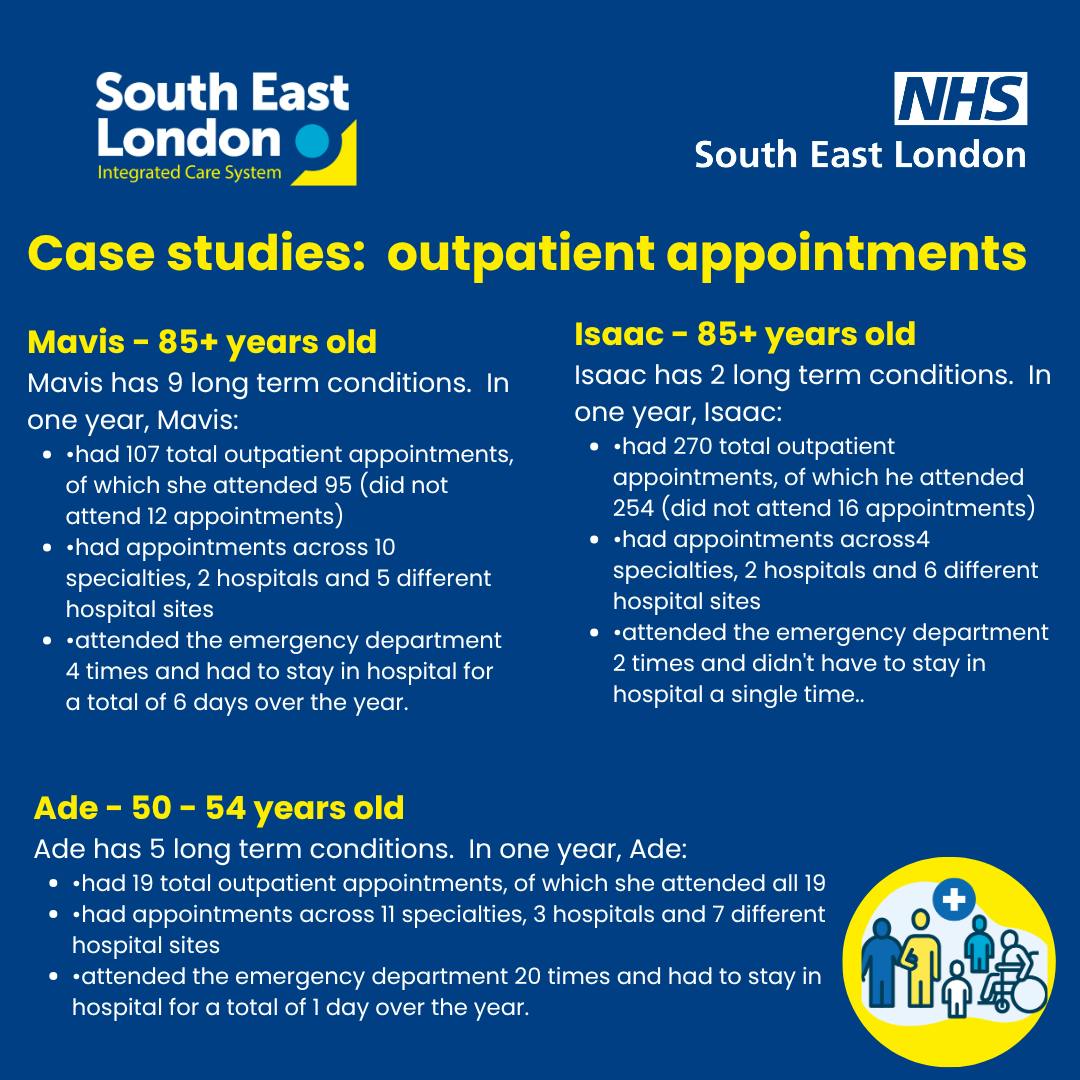
Sometimes, when a patient has many health conditions or more complicated care needs, they may be seen by different healthcare professionals at different hospitals and under different specialities. For example, for patients with type 2 diabetes whose condition is more severe, they may need to be seen by an ophthalmology team to prevent vision loss, a podiatry (foot health) team to help with foot ulcers, a renal team to monitor their kidneys, and a cardiovascular team to prevent them from heart attack or stroke, as well as their GP for regular check ups. When health care becomes split between multiple different specialities and hospital sites, this is called ‘fragmentation’ – your care is broken up into smaller fragments rather than being managed by one team or person.

In many cases going to different hospitals or being seen by different specialists helps you get the highest quality and most relevant care for your needs. However, sometimes fragmentation can happen because different services don’t communicate with each other and processes don’t work as well as they should. This can lead to patients having to travel to unnecessary appointments, having to retell their health story and repeat tests numerous times, and being told different information by different healthcare professionals.

We believe that this problem may happen more commonly for people who have lots of different long-term conditions to manage, who are older and/ or frailer, and those who experience other social and financial inequalities.

Why is matters and what we are doing

We are working with the Health Innovation Network (HIN) South London to understand why ‘fragmentation’ happens, when and where in the patient journey that care becomes ‘fragmented’, and what happens as a result. We will be analysing the insight and data to understand patterns and trends, speaking to patients to understand their experiences and healthcare professionals and other staff working in different health care settings.

Having a better understanding of why fragmentation happens and when it can have negative results for patients will help us improve south east London health care services. We will share what we have learned with local teams, hospitals and other healthcare organisations so they can better understand when problems happen and start to create ways to solve these problems.

Get involved

We are planning to carry out up to 10 in-depth conversations with people. If you have you been treated in hospital outpatient clinics in the last two years for any of the following conditions, or you are a carer of anyone who has been in hospital in the last two years for these conditions, we would like to hear from you. Please fill in this short form and we will be in touch.

  • Heart conditions (e.g. high blood pressure, heart disease)
  • Kidney problems
  • Diabetes or other metabolic conditions
  • Frailty (e.g. falls, weakness, multiple health issues)

We will also be publishing a survey soon to understand the views and experience of more people. Watch this space!

Background

Sometimes, when a patient has many health conditions or more complicated care needs, they may be seen by different healthcare professionals at different hospitals and under different specialities. For example, for patients with type 2 diabetes whose condition is more severe, they may need to be seen by an ophthalmology team to prevent vision loss, a podiatry (foot health) team to help with foot ulcers, a renal team to monitor their kidneys, and a cardiovascular team to prevent them from heart attack or stroke, as well as their GP for regular check ups. When health care becomes split between multiple different specialities and hospital sites, this is called ‘fragmentation’ – your care is broken up into smaller fragments rather than being managed by one team or person.

In many cases going to different hospitals or being seen by different specialists helps you get the highest quality and most relevant care for your needs. However, sometimes fragmentation can happen because different services don’t communicate with each other and processes don’t work as well as they should. This can lead to patients having to travel to unnecessary appointments, having to retell their health story and repeat tests numerous times, and being told different information by different healthcare professionals.

We believe that this problem may happen more commonly for people who have lots of different long-term conditions to manage, who are older and/ or frailer, and those who experience other social and financial inequalities.

Why is matters and what we are doing

We are working with the Health Innovation Network (HIN) South London to understand why ‘fragmentation’ happens, when and where in the patient journey that care becomes ‘fragmented’, and what happens as a result. We will be analysing the insight and data to understand patterns and trends, speaking to patients to understand their experiences and healthcare professionals and other staff working in different health care settings.

Having a better understanding of why fragmentation happens and when it can have negative results for patients will help us improve south east London health care services. We will share what we have learned with local teams, hospitals and other healthcare organisations so they can better understand when problems happen and start to create ways to solve these problems.

Get involved

We are planning to carry out up to 10 in-depth conversations with people. If you have you been treated in hospital outpatient clinics in the last two years for any of the following conditions, or you are a carer of anyone who has been in hospital in the last two years for these conditions, we would like to hear from you. Please fill in this short form and we will be in touch.

  • Heart conditions (e.g. high blood pressure, heart disease)
  • Kidney problems
  • Diabetes or other metabolic conditions
  • Frailty (e.g. falls, weakness, multiple health issues)

We will also be publishing a survey soon to understand the views and experience of more people. Watch this space!

  • If you are interested in helping us understand your experience of having many different outpatient appointments in different hospitals and settings please complete this short form and we will be in contact. We want to understand your experience so we can improve how services are organised for people with more than one long term condition. 

    It takes two minutes to complete.

    Complete Form
    Share Sign up to help us understand your experience, or the experience of the person you look after, of having many different outpatient appointments. on Facebook Share Sign up to help us understand your experience, or the experience of the person you look after, of having many different outpatient appointments. on Twitter Share Sign up to help us understand your experience, or the experience of the person you look after, of having many different outpatient appointments. on Linkedin Email Sign up to help us understand your experience, or the experience of the person you look after, of having many different outpatient appointments. link
Page last updated: 11 Jun 2026, 03:32 PM