Help shape the future of women's bladder care
Local hospitals, King’s College Hospital NHS Foundation Trust, Lewisham and Greenwich NHS Trust, and Guy’s and St Thomas’ NHS Foundation Trust, are working together to improve care for patients experiencing bladder incontinence and pelvic health issues.
Urogynaecology services across south east London have faced long-standing challenges: inconsistent access, under-resourced community services, and delays in diagnosis and treatment. In response, we are working with people with lived experience to develop new ways to deliver care that are more efficient, equitable and centred around what matters most to patients.
The programme’s overarching goal is to deliver timely, high-quality care closer to home, while reducing unnecessary hospital referrals and improving patient experience. Key objectives include:
- Strengthening community-based services such as physiotherapy and continence care.
- Introducing Community Assessment/ Education Days (CADs) for early intervention and holistic support.
- Streamlining referrals through a Single Point of Access (SPoA).
- Enhancing workforce training and retention.
- Promoting consistent use of clinical guidelines and patient education.
Community education days and on-line preview session
We put on three community education days in May and June 2026 to address issues that women have raised in the focus groups in January 2026 and August 2025 (you can read the key themes below). The days will provide opportunities to:
- take part in bladder training and pelvic floor muscle exercise classes
- understand the lifestyle changes that will improve urinary and pelvic floor symptoms
- get advice and information to manage symptoms
- find out about local services and resources
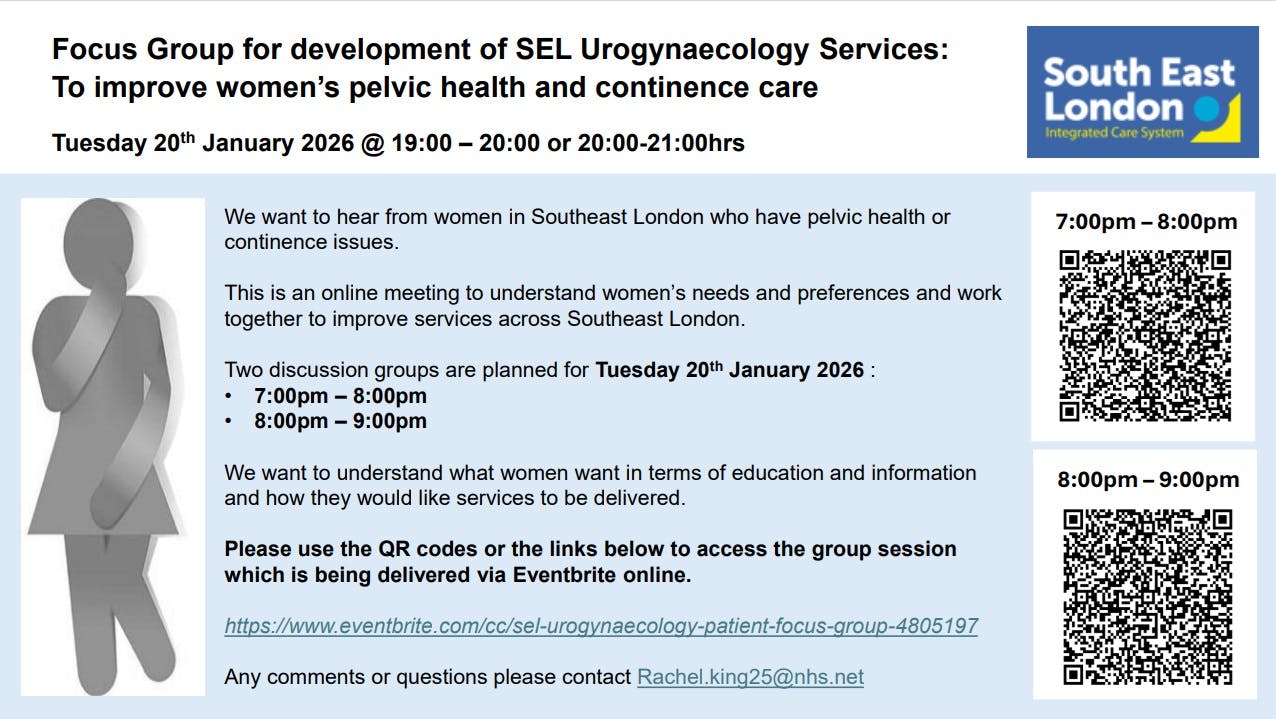
We put on a preview online session on Monday 27 April, 7 - 8 pm where we will started to demystify and break the taboo around continence issues. There is more information on the poster to the right.
Listening to people with lived experience
We are working with and listening to local people experiencing symptoms related to pelvic organ prolapse, urinary/bladder incontinence, pelvic health issues or other urogynaecological conditions as well as newly diagnosed or have been managing symptoms for years, your insights are valuable.
We held two focus groups in January 2026 with women with lived experience of urogynaecological issues and clinical staff to explore how community based education days and supporting information resources could better meet women’s needs. These followed on from two focus groups held in August 2025 where the lack of awareness of resources and the need for better information and community education sessions were raised.
Key themes that were raised at the sessions included:
- embarrassment and silence around these issues which often delays seeking care and support
- the need to frame community days as informal, women-centred gatherings rather than clinical appointments in non-clinical venues with good transport links to help reduce stigma
- the need for lifelong messaging around bladder issues and not just after having given birth as bladder issues can affect women and girls of all ages with a focus on:
- education aimed parents, girls and schools including puberty aged girls
- messaging aimed at menopausal aged women
- the need to be inclusive and address both cultural and literacy issues with suggestions of
- being able to submit questions anonymously
- being able to submit audio or video questions
- providing multi-lingual resources
- being able to have hands on demonstrations of different products.
You can read the full report here.
The recent focus groups build on what we heard in two focus groups that took place in August 2025 where people attending had the opportunity to share experiences and insight on how bladder care is delivered across our hospitals, as well as in the community.
Key themes included:
- Limited access and long waits, for physiotherapy and follow-up support
- Embarrassment during treatment and lack of specialist advice
- Challenges managing long-term conditions like self-catheterisation and infections
- Concerns around ageing, incontinence products and GP access
- Desire for clearer, tailored resources (e.g. leaflets with visuals)
- Need for guidance on diuretics and self-management tools
- Lack of awareness of digital resources and national charities.
- Community education sessions on bladder retraining and pelvic floor exercises were positively received. Suggested promotion via GP surgeries, libraries, community groups, and health buses.
- Long journeys – often years – for women with pelvic floor or bladder issues
- Perceived ‘lack of urgency’ by GPs
- Participants welcomed continued involvement through follow-up meetings and feedback opportunities.
- Women were happy to work to review any patient resources.
- The idea of community education days was well received with women recognising the value of peer support involved
This work will continue to be shaped by women with lived experience, who have expressed a strong desire to stay involved as resources and community education approaches are further developed.
-
-
Clinical Chair, Consultant Nurse in Uro-gynaecology
King’s College Hospital NHS Foundation Trust